|
This temple fronting the river mouth is located at
Tambon Tha Chalom on the western side of the Tha Chin River. It was
constructed during the Ayutthaya period. Religious buildings in the
temple have been beautifully renovated. The windy area by the sea is
used as a rest area for the locals.This temple is popular with Chinese visitors because of the Jao Mae Kuan Im Shrine. Here you can see a 9 meter high statue of the Mahayana Buddhist Goddess of Mercy.
|
|
|
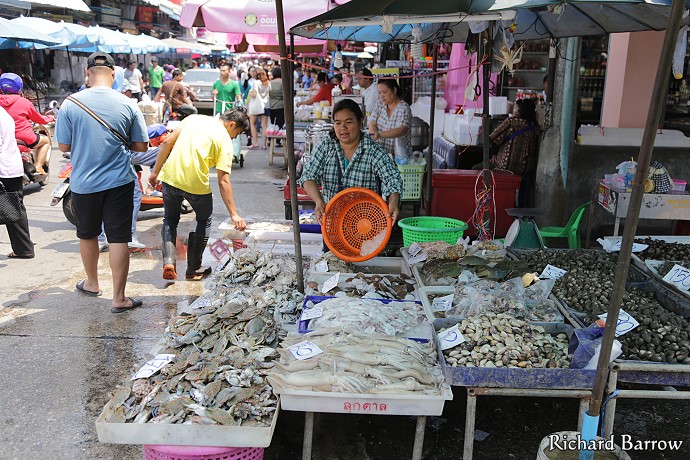
This is one of Thailand's largest traditional fresh
seafood markets, but visitors can find much more than seafood,
especially if there is time to spare. Handicrafts such as wicker
furniture, pottery and local sarongs are among the colourful offerings
in the market. Crossing the river from Mahachai to the west bank,
visitors will arrive at Tha Chalom, a large fishing village and
industrial land for marine products.
|
|
|
This is regarded as the symbol of honesty. It was
erected to be a memorial to Phanthai Norasing, a man of integrity of
the Ayutthaya period. The historic event occurred in 1704 when Phra
Chao Sua, a king of Ayutthaya, made a royal visit by the Ekkachai royal
barge via the curved Khok Kham Canal. Phanthai Norasing, who was the
coxswain, could not operate the steering, thus causing the prow to be
broken by hitting the limb of a tree. To foster the palace law, the
coxswain then begged the king to slaughter him although he was
forgiven. After his death, the king built a shrine in Khlong Khok Kham
and commanded to have a new canal, later named Khlong Mahachai, dug to
eliminate the sharp curves of Khok Kham Canal. A cruise along the canal
via mangrove forests and fishery villages is organised by Khun Narin
Bunruam Tel: 0-3441-2490.
|
|
|
Located on Highway No.35 with a left turn after
crossing the Tha Chin River, this is an ancient temple presumed to have
been built during the Ayutthaya era. The doors and windows of both the
old and new chapels were neatly and beautifully carved in various
floral designs. It is believed the craftsmen were Chinese, as the
carvings include some Chinese trees.
|
|
|
This fortress is located near the city pillar
shrine in the town. It was constructed in 1827 during the reign of King
Rama III to prevent sea invasion by an enemy. It can be seen as ruins
nowadays. The cannons, which used to be housed in the fortress, are now
displayed at the city pillar shrine and the city hall.
|
|
|
Wat Khok Kham is an ancient temple located by Khlong Khok Kham. It is
accessible by going along Highway No. 35. Turn left to Wat Phanthai
Norasing for 3 kilometres. The interesting part of this temple is the
old ubosot decorated around with Sema boundary markers. At the front of
the temple lies a renovated chedi in the Ayutthaya style of art. The
wooden engraving design at the gables is beautiful. Besides, there is a
Phanthai Norasing Shrine which was a temporary shrine and a store of
antique objects concerning the story of Phanthai Norasing such as parts
of the Ekkachai and Butsabok royal barges, etc.
|
|
|
The temple is located in Tambon Bangyapreak near the bank of Tha Chin river. It is estimated to be built around the early Rattanakosin and is about 176 years old. It was built by the Mon people from Burma who live in the village nearby. There are many burmese people living and working in this area that you can see many signs written in Burmese.
|
|
|
Samut Sakhon is the biggest producer of brine salt.
Its picturesque salt farms, which sprawl across the border with Samut
Songkhram and along the Thon Buri-Pak Tho Highway, have provided a back
drop for many holiday snapshots.
|
|
|
This temple was built in the early Rattanakosin period by the local Chinese who called themselves "Kok Kak". The temple hold one of the biggest temple fairs in Samut Sakhon around January every year.The special attraction for this temple is the monk image and a Buddha image wearing sun glasses. The whole temple is also made from teak wood.
|
|
|
Wat Si Suttharam or Wat Kam Pra is the temple where the Prince Chumphon statue is located. Prince Chumphon is respected by local fisherman who look on him as a kind of patron saint of sailors. Prince Chumphon was a son of King Rama V and the founder of the modern Thai navy. He is celebrated as the "Father of the Thai Navy". His statue can be found at many seaside towns and villages.
|
|
|
The City Pillar Shrine is situated near Pom Wichian Chodok and is a
sacred place, as well as, a centre of the heart of the fishermen in the
province. Every time before sailing off, they have to pay respect and
light a firework in front of the city pillar shrine for good luck.
|
|
|
Khlong Khok Kham is a very winding canal. Some parts of it are
90-degree curves. The tide is so strong that it is very difficult to
control a boat. This caused an accident when Phrachao Suea or Somdet
Phra Sanphet VIII (1703-1709) went along Khlong Khok Kham on his
private trip by the Ekkachai royal barge. The barge hit a branch of a
tree and Phanthai Norasing as the steersman took responsibility by
being executed.
|
|
|
Saphan Pla is the biggest fish bridge and a modern one, second only to
that in Bangkok. It is located in Samut Sakhon municipality. Modern
facilities are utilized to transfer large amount of sea products in
every kind. Also, it is a wholesale centre of sea fish.
|
|
|
The Ao Mahachai Mangrove Forest Study Centre offers
a nature trail along a mangrove forest around the Tha Chin Estuary.
From the town, take Sutthiwawithi Road for 2.5 kilometres, then turn
left and proceed for 6.5 kilometres to the centre.
|
|
|
Wat Ratsatthakayara, Tambon Lak Sam, Amphoe
Ban Phaeo is where thousands of birds live in peace among
the bushes. Migrating mangrove birds can be found along
the muddy shore between the Tha Chin and Mae Klong Rivers
during the cool season.
|
|
|
It is situated at Mu 10, Tambon Tha Mai, near the basketball
court in Ban Plong Liam School, on the bank of the Tha Chin River.
Plong Liam is a chimney of a Portuguese sugar factory, called Captain
Hit. It was built in 1824 during the reign of King Rama III. It is a
chimney made of bricks and cement on a 4 metre-width and 4 metre-height
square base. From the base rises an octagonal chimney. Each side is 1
metre wide and its overall height is 30 metres.
|
|
|
Wat Nang Sao is located in Tambon Tha Mai. Take Highway No. 35 (Thon
Buri-Pak Tho) to Highway No. 3091 for approximately 5 kilometres and
turn left into Soi Wat Nang Sao 2 for 1 kilometre.
|
|
|
Samut Sakhon Science Centre for Education is
situated in Tambon Khok Kham, 1 kilometre from Wat Khok Kham. It is
under the Office of the Non-Formal Education Commission, Ministry of
Education. It was established in 1997 in an area of 18 rai. Inside the
building lies an exhibition on astrology and space under the title of
the Earth and Solar System, Exploration to the Moon, Life of Fixed
Stars with a projector presenting stars in a small dome, a presentation
in the Mini Theatre, and an exhibition entitled “Human Beings and
Measurement and Calculation”, telling about the long history of
measurement and calculation. Outside the building, scientific gardens
are organized such as geological garden, health garden, physics
amusement park, organic agricultural garden and herb garden. The
activities are blended with the original and natural geography. It is
open daily from Monday to Friday, 8.30 a.m. to 4.30 p.m. For more
details, please contact Tel. 0 3442 1014.
|
|
|
Ban Don Kai Dee in Krathum Baen District of Samut
Sakhon Province where the famous Benjarong porcelain is made . The
ceramics produced here are of the finest quality and are much sought
after by collectors, universally admired for the beauty and grace of
their unique form, design and colour.
|
|